
Todd Watts' Artistic Expression
By John McNamara
Guilford Register, March 2026
Nestled in the woods of Northern Maine, Blanchard Township is a beautiful, wooded landscape. In that town, along the Piscataquis River, sits a home that once belonged to Berenice Abbott, an American photographer best known for her portraits of cultural figures of the interwar period, as well as New York City photographs of architecture and urban design of the 1950s, among other works. Next door, you will find Todd Watts and the Abbott Watts Residency studios.
When I arrived on a cold, winter morning, the ground was still covered in snow. The roads were a mixture of ice and sand. It was a winter wonderland in every direction, and it was cold. Todd and I began my tour in his editing studio, a building he and his wife, sculptor, Jemma Gascoine built some years earlier as her ceramic sculpture gallery, in Blanchard, before moving it to Monson and establishing the Gascoine Gallery and the Monson Pottery. It was warm inside, and one wall of all windows looked out over the frozen Piscataquis River. A sight that I suspect is quite stunning in the spring when all the snow melts, and the river rages south. It is a perfect room to create.
The other walls are covered with shelves of art books or some of Todd's work, all large, framed works of art. I feel compelled to call them works of art, not photography, because of the unique process Todd uses to create each one. Throughout my career in the art world, I have spoken with many photographers—even shown many of their works in my galleries. Those photographers were much more traditional—landscapes, nature, people. You could look at the image and see the beauty in the detail, the lighting. The photographer waited for the exact moment to capture the shot. Some of them would adjust color and contrast on the computer before printing and mounting an image for a gallery. Todd is not that kind of photographer.
Todd grew up in New York. He went to the High School of Music and Art and later to the School of Visual Arts. He studied painting, sculpture, and drawing—all types of art. He loved art—still does—but was not sure what he would do for a career. He was too focused on studying all of the elements of art and enjoying the process. As part of his graduation, he needed 35mm slides of all his work—his paintings, sculptures, etc.—but before he could hire one of the photography students to capture his portfolio, they had all left for the summer. Unsure of how he would photograph his artwork, Todd went walking through campus when another student, a rich kid, stopped him and told a story about how his father would not give him any more money. The kid had a beautiful Nikon camera and was willing to sell it to Todd for $100. One desperate for cash and the other desperate to graduate, a deal was made. Todd bought his first camera and graduated. After graduation, Todd packed his car and drove to Haight Ashbury in San Francisco. He then spent four months in California with that Nikon, taking photos-almost 3,000 in total. He had fallen in love with the camera—with photography. That serendipitous moment with the rich kid gave us the Todd Watts we all know today.
His first foray into real photography work was architectural photography—photographing buildings. He and his upstairs neighbor in Tribeca, over a bottle of bourbon, decided to start an architectural photography company. For a couple of years, the two of them photographed buildings all over the US before a girl got involved—love got in the way, and the two decided to shutter the company. That is when Todd stepped into teaching photography at the School of Visual Arts.
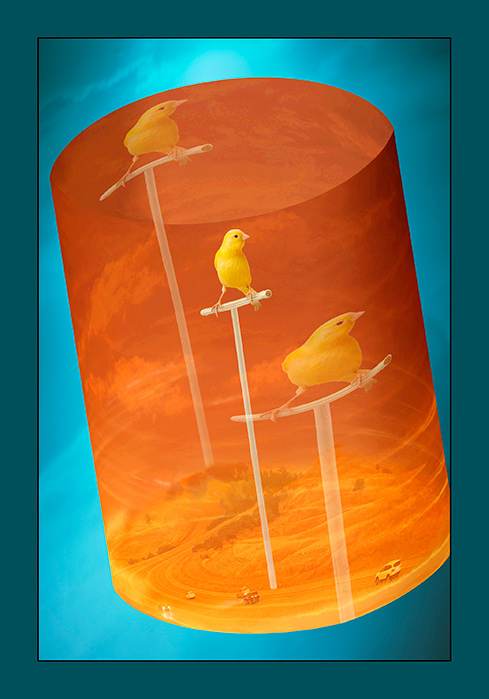
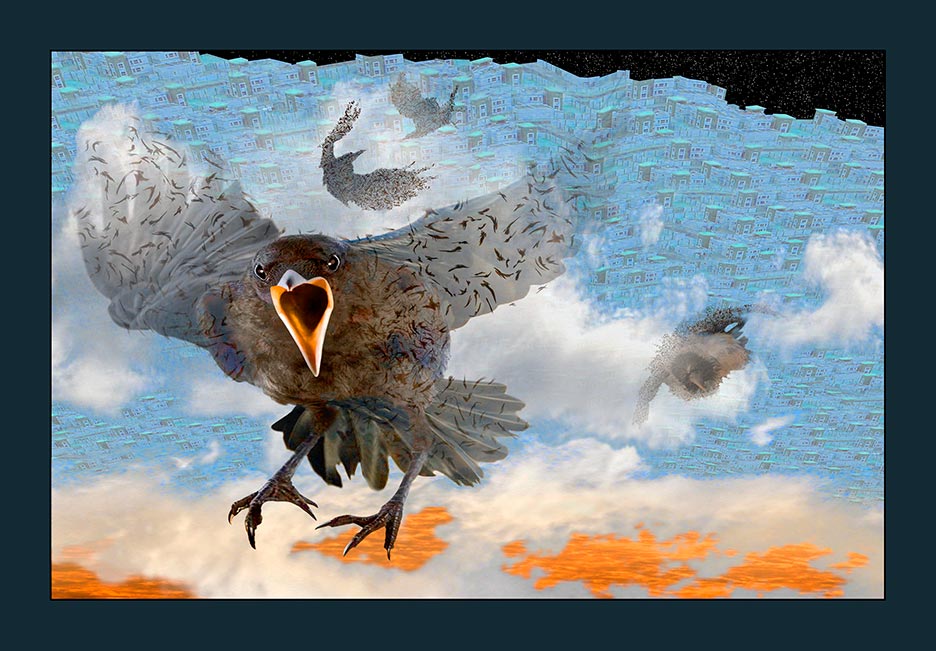
Today, Todd creates large-scale works of art; not photographs. A photograph is his canvas—his first layer. Each of his works is a multi-layered abstract image that includes hundreds or thousands of components. One of his more intriguing works, called Blackbird, includes more than 2,000 images of birds. This is just one example of how much time and energy Todd puts into each work. He does not take photos and then alter or enhance them. Instead, Todd comes up with a concept for an artwork and, using one photograph as the 'canvas' for his work, he lets it speak to him. He adds layers of photographs to create a truly breathtaking abstract image. His work is in museums around the country, and you can see some in his wife's gallery in Monson, the Gascoine Gallery. These are works that need to be seen in person. It is only then that you can get up close and see the multitude of details. Of course, a private tour of his studio, as I got, will give you the story behind the works—the journey from start to finish—and those stories that Todd shared helped me see his work from a whole new perspective.
Today, Todd has the quaint studio where we began our interview, but across the road, he has a much larger facility used for printing, storing, and preparing works for shipment. Both buildings are surrounded by nature, and Todd built them so nature could be enjoyed from inside. Windows wrap the buildings, letting swarms of natural light fill the spaces.
In the mid 1970s, Todd worked with Berenice Abbott on a project in New York—photographing traffic. They spent weeks together as Berenice was driven around the city, sitting in the back of a convertible Porsche, taking photos of traffic. That project did not produce the images Berenice hoped for, so they scrapped that project, and Berenice invited Todd to Maine to work with her on printing a portfolio of her work. Todd spent two months living in Berenice's home, making her prints. That led to Todd buying the empty house next door to Berenice, and from time to time over the next 16 years, the two of them worked on a plethora of projects together. Todd remained in New York to complete most of the work, but over time, he needed to enlarge his studio and not finding suitable space he decided to renovate the house in Maine and move into it in 2000. He has been producing incredible works in Maine ever since.
His big studio across the road became part of the Monson Arts Residency program in 2021 with the formation of the Abbott Watts Residency for Photography. That program accepts photographers from around the world each year, and you can learn all about it here (www.monsonarts.org/residencies/abbottwatts-residency).
The lucky resident photographer lives in an ultra-cool residence in Monson and come to Blanchard to work with state-of-the-art equipment to help bring their vision to life. Still, probably the most important part of their residency is the time they spend with Todd, learning the trade, listening to his stories, and hearing about the journey of photography over the decades.
Of all the art and photography throughout the larger studio, it is hard not to notice the dozens of masks, large and small. Funny ones and scary ones, too. Some are simple in design and material, while others are quite elaborate. This collection began with Todd buying a mask he liked in SoHo. Before he knew it, friends were buying him masks for holidays, birthdays, etc., which has resulted in quite the collection that includes a Canadian child's hockey goalie mask, a 1930s catcher's mask, a US Navy cold-weather mask, and other various masks from around the world.
Todd's first book, the Blanchard Weather Report, which is a must-buy, began as an email. Todd would send a photo of the day's weather to a few friends. Those emails got forwarded around, and soon more than 250 people wanted to sign up to receive them, so the logical next step was to take all those photos and produce a pictorial weather report. The photographs are not documentary. Instead the reader is taken on an emotional journey through the four seasons of Maine, and all the weather-wonderful nature locals take for granted up here. For someone new to Maine, the Blanchard Weather Report has been an enjoyable "read." (Available at Brickyard Books and on Amazon.) I have enjoyed how Todd has captured the beauty of this corner of the world throughout the year.

Like many artists, the concept of "retiring" is not in Todd's vocabulary. He is deep into his second book, which will be a little different than Blanchard Weather Report. In this second book, the reader will experience what Todd experienced when he made the photos. This book pairs words and images, with the words focused on the experience of when the photograph was made rather than an explanation of the photograph, which I think is a fascinating approach to talking about photography, and for art lovers who crave hearing the "how" and the "why" an artist creates something, this book will be for them. It will be like being in a gallery with the artist right next to you.
He does what he loves, and he loves what he does. He cannot imagine not being creative, so for the foreseeable future, Todd will continue to produce a few works each year and keep his studio doors open to photographers who want an experience of a lifetime. And for anyone who follows Todd's work but has not had a behind-the-scenes tour, as I recently received, you should reach out to him. It is an absolute joy listening to Todd share his life story. See more of Todd's work at www.toddwatts.com.